When you are young and very inexperienced, your attractions tend to lean towards those with pretty faces and good physiques, such as strawberries and corn. Thinking back now, such flings now seem somehow trivial or superficial. Give me strength and character over looks any day. – Victoria Renoux, For the Love of Garlic
This is it. Our last bulb of garlic from last year’s garden.
I knew this day would come, but I didn’t anticipate how bummed I would be. The only thing left to do now is get out in the yard and tend the garlic we set in place in November and hope it will grow to be powerful and potent by the time we harvest it in July. (That and head to the winter farmer’s market with fingers crossed that someone there has something tasty to get us through the next 3 months.)
Put 40 amateur urban farmers in a room with an Extension Educator to talk about vegetable production planning, and it’s bound to get personal. Everyone has a pet product they want to know how to grow better. And so it was Wednesday night at farm school. One person asked why her onions never get much bigger than a golf ball. Another wanted to know what was eating her radishes. I wanted to know how to keep the flea beetles off my arugula.
Jacqueline Kowalski, who also led our session on soil, did a nice job balancing these queries with her prepared remarks about vegetable production planning, tomato production (yes, this was a presentation onto itself – they are that popular!), and plant nutrition. As with all the other sessions, I heard some things I knew before, but from a new perspective, and had my mind opened to new things I’ll need more time to consider and explore.
Jacqueline likes to teach through problems and for this session she presented us with questions we answered by looking up information in the Johnny’s Selected Seeds catalogue. I found myself drifting from the assignments – for example, “You have an order for 500 Wee-B Little, 500 Snowball, and 500 Baby Bear pumpkins. How many plants do you need to grow?”or “What are the best lettuces to grow in the summer?” – to drooling over the season extension supplies featured in the back of the book. I returned to the group consciousness for the answers to our assigned questions and learned some new strategies for reading the seed catalogues and analyzing and selected varieties to grow. Then, when I got home I placed a great big order for row covers and and other supplies that have been on our list through Johnny’s website.
We talked at length about starting seedlings, intercropping, succession planting, crop rotation, and fertilizers. So much interesting and useful information to refer back to and share with you all as the season grows on. Hard to believe, but next week is the last session of farm school.
Finally. It’s been warm enough for three days in a row to go outside with no coats! Our bikes are out again, as well as our shovels. The soil finally thawed deep enough to get our soil sample ready to send down to OSU for testing. (More on our burgeoning partnership with Kerry Ard and the School for Environmental and Natural Resources later…) The test will help us understand what is, and what is not, in our soil at this point and how to amend it to make it the most hospitable home for our plants as possible. First sign of good news; we found tons of earth worms!
Softer soil meant we were also finally able to push our low tunnel hoops down far enough into the ground to stabilize them. They are set in the raised beds on our side of the fence for now but, if all goes as planned, we’ll be getting a BIG dump of compost at the end of the month and will install some over the fence as well. We’ll be having a few gorgeous days early this week that will be great for planting out the seedlings we’ve been hardening off (see below). Though we’re wondering, should we put them out there with snow and ice in the forecast for Thursday? Gotta love Ohio in March!
If all goes as planned, we’ll be able to serve our CSA members a sneak peak of what’s coming their way during our upcoming work days!
This week’s farm school session was by far the best yet. Denise Ellsworth was the most dynamic instructor we’ve had and the three hours whizzed by. (The art educator in me is convinced this is in some way related to the fact that she started her college career as an art history student.) Denise had so much information to share she ran out of time, which was kind of a bummer. Some of what she shared was a little unnerving – there are so many natural threats to a good harvest – but in this game it’s best to know your enemies. Thankfully, she provided lots of resources we can use to get started on the right foot, to expand on what we’ve been doing well, and make changes as we move forward. She also taught us a thing or two about our allies. I can’t wait to use some of these tips to more effectively lure the bees from the hive down the block to our yard. (Thanks, Jen and Tim, for letting them come over to play!)
Here are the top five things I took away from the evening:
If you see fungus, it’s too late to treat it.
If you want to have a healthy garden, you have to take a long-term and proactive approach to pest management. This includes understanding the culture of your landscape – “how actions impact balances and relationships.” There is so much happening beneath and around our plants that we need to be aware of. Too often we focus too intently on the plants themselves. Attention to drainage, air flow, and crop rotation are examples of areas for pro-action.
Banish old tomato plants from your kindgom. Most backyard compost piles don’t get hot enough to kill the diseases and pests tomato plants can accumulate over a season. It’s not worth risking next year’s crop by holding onto any part of these plants. Pull roots completely and remove all fruit and foliage from beds as soon as the harvest is over. Bury the remains somewhere in the yard a foot down or put them in the trash. (Need to find out whether they can be put out for city yard waste pickup. Do their piles get hot enough or are we just spreading the disease throughout the city?)
Embrace your inner scientist. Scientists’ work develops from observation-based questions. Come this spring I’ll be “scouting” for problems in the garden everyday, then exploring options for addressing them. For example, if I see insect “frass” (aka bug poop), I’ll follow the trail and see where it leads and take action based on what I see. I’ll record the “ground truth” for weather related patterns as they arrive at our property like “growing degree days” as they pass.
Be the hostess with the most-ess. Invite pollinators into your “insectary” and show them a good time. Find ways to provide a successive feast with at least three pollen sources spring, summer, and fall to keep them around your property rather than flying off to the next way station. That’s gonna take some research and planning. We’ll start by rearranging some of our perennials in groups and by incorporating flower beds throughout and around the the farm. This will help us create” corridors of connectivity,” or highways, for bees and butterflies to follow through your space so they don’t have to cross scary pathways where predators might gobble them up.
The more you grow, the more you need to know.
As urban farmers growing a variety of things in small spaces, we are both at an advantage and disadvantage over the large-scale, one product grower. We’ll need to learn the ideal growing conditions for a wide variety of plants. At least we won’t ever get bored.
It’s bitterly cold here in Central Ohio, again. But, I’m convinced this is the last of it. Snow and ice in the forecast this weekend, then I’m hoping we can keep temperatures in the 20s and 30s with some sunshine through March. I can handle that. I’m over this polar vortex business.
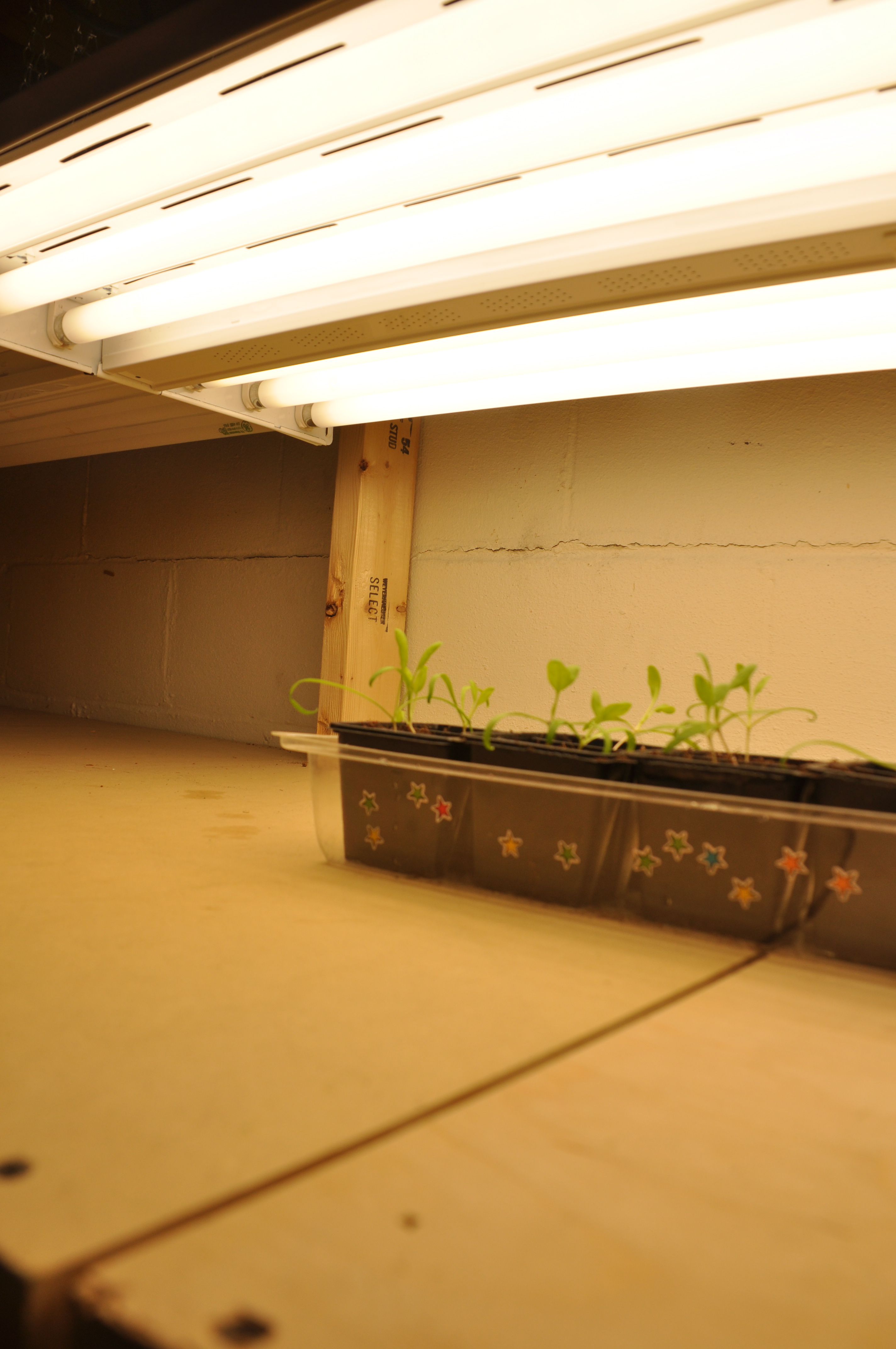
Yesterday, Dan was off from work so we could attend Rosa’s 6th grade lip sync – a welcome respite from the winter blahs. After that, we chilled out a bit and got our grow lights hung.
We set them up on a few storage shelves I cleared off in the basement. They are out of the way and I figure if we do this every year, we’ll be forced to go through the junk that accumulates down there all year long. Two points!
The lights are so bright I’m thinking of moving my office down there. Not really, but they are lovely – never thought I would say such a thing about fluorescent light fixtures. Dan’s one of those guys who always “knows a guy” to help us out with great prices and services and these high efficiency fixtures were no exception. They are pricey and I’m not sure we would have made the investment at retail price. While I’m super excited to be growing stuff in February, I’m wondering how much money we’ll save in the end, if any, by starting our own seeds. I suppose I should count up how many plants we end up growing and compare our costs with retail prices. Report on that sometime in May.
We are pleased to announce that our CSA subscriptions are committed for the 2014 season! We are humbled by the outpouring of support we have received from family, friends, and neighbors for this project and look forward to working for, and with, you all in the coming months. Our hope is that over time our members will outgrow their need for us, as they learn skills to use in their own edible backyards, making room for new members. So if you missed your chance to be part of the action this year, have no fear, there will be others!
Also, as the season progresses, we’ll post surplus produce available for purchase on our Facebook page. If you haven’t “liked” us there yet, wait are you waiting for?
One of the things we’re most excited about experimenting with this spring and fall are tunnels – high and low. Tunnels are used to extend the growing and harvesting seasons. A tunnel over a garden bed creates a microclimate which magically transports the soil and air 500 miles south. So, in the spring, we can use low tunnels to get a jump on the growing season, and in the fall, we can use them to protect crops from the frost. The tunnels will behave similarly to our coldframe.
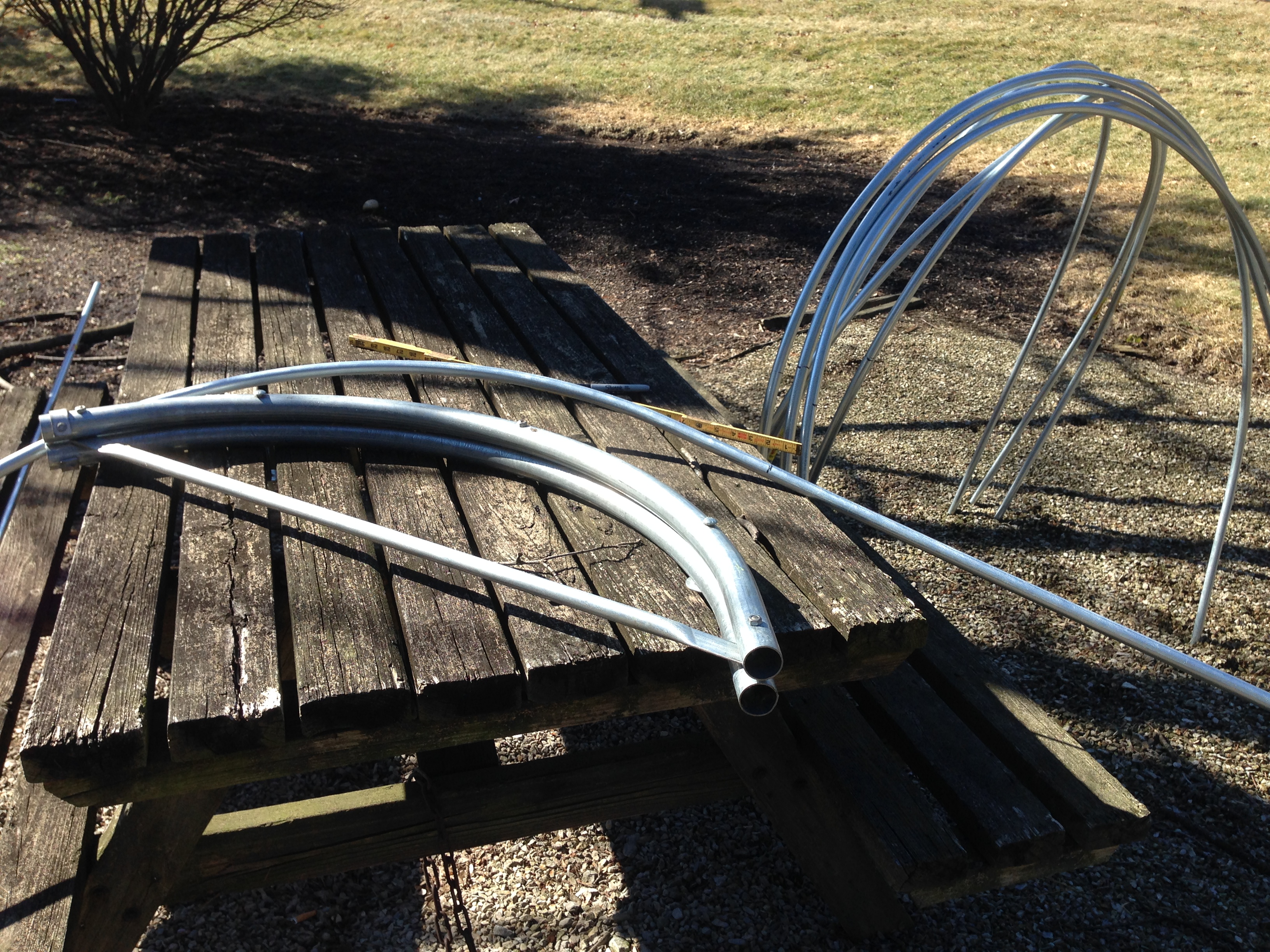
Last week, Jesse Hickman of Local Matters – Columbus’s leading non-profit dedicated to “transforming the food system” and a co-sponsor of farm school – offered to lend me a low hoop bender the organization owns. I jumped at the opportunity and made use a few recent sunny days with temperatures over 30 degrees to give it a spin. I stabilized the bender on picnic table in a green space behind a bank and a funeral home at the end of our block and set to work. Dogs from adjacent lots were barking at me and I was waiting for the bank security to come ask me what I was building. All part of the urban farming experience, I suppose.
As Jesse predicted, my first attempt at bending the 1/2 inch electrical metal conduit was a wonky, lopsided mess. But I quickly got the hang of it and we now possess 16 hoops 4 ft in diameter and 4 feet high. Hope to install these guys the second week in March and move some seedlings into them. Will also be experimenting with direct seeding under the tunnels. Stay tuned…
This past fall we were on a tour at Swainway Urban Farm when our pal Milan, from Peace, Love, and Freedom Farm, asked Joseph Swain who inspires him. It was a great question and without hesitation, Joseph cited Eliot Coleman, the guru of Four Season Farming. I was somewhat familiar with Coleman’s work from articles he published in Mother Earth News, but we promptly checked a few of his books out from the library and haven’t looked back.
In Four Season Harvest (1999), Coleman offers advice on sowing seeds and raising seedlings in the coldframe. Knowing full well we are in for a few more weeks of very cold weather, we decided to give his method a try today as temperatures soared above 50. As promised, I picked up a soil thermometer and found the soil was fluctuating between 45-60 degrees for the past few days. Perfect for kale, beets, onions, chard…
With the coldframe already cleared of old growth and the soil smooth, we laid a 2-3 inch blanket (about 1 yard) of Happy Frog Potting Soil over all but the small section where we transplanted some seedlings earlier in the week. We set the seeds down in well marked rows and gave them a drink. And now, we wait.
It used to be if I heard the term “seedbed,” my thoughts turned to performance artist Vito Acconci’s (1972) work of that title. If you don’t know it, look it up. (Just be warned, this work is not appropriate for all readers.) I won’t go into it here except to say, that I have new understanding of the term. These seeds are warm and cozy and we’re going to do all we can to keep them that way.
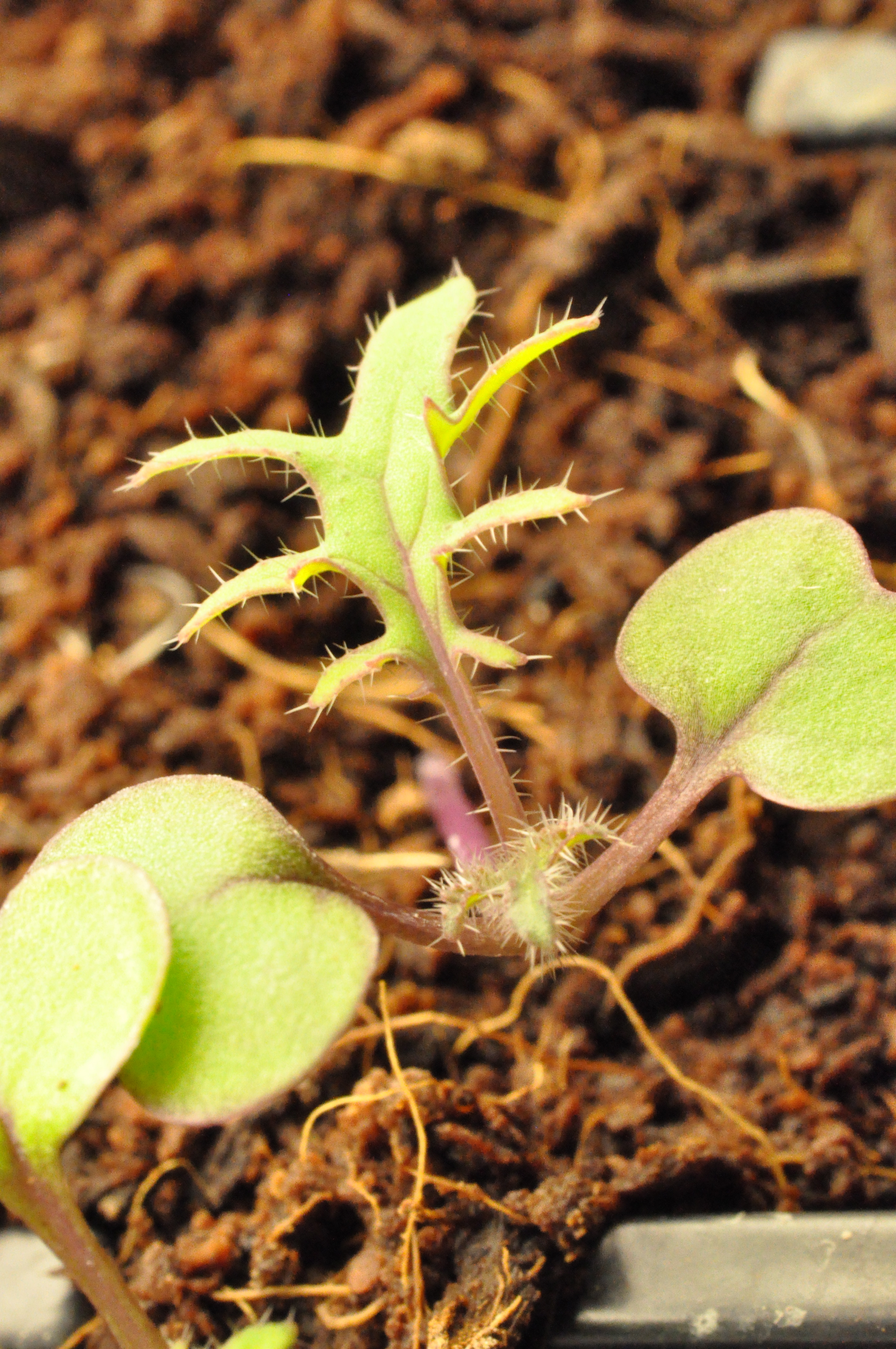
[Quick note on the transplants. They seem to be doing okay. We moved a few straw bales that were lying around to the west and southwest sides of the coldframe as a windbreak to help these next last few weeks of winter. The transplants aren’t growing as fast as the seedlings still sitting in the kitchen, but they are holding their own, gaining inner strength and waiting to flouirsh as soon as temperatures stabilize. As soon as the grow lights we got are installed, we’ll move some of the guys on the windowsill under there and then they will really start to take off. Can’t wait!]







 Over the Fence Urban Farm