I have so many thoughts to try to organize on the subject of this post. More posts will be necessary. Consider this Part I.
Three years ago I wrote an article for the art education journal Artezein (see Art Education in my Backyard) about the farm as it relates to and benefits from my training and experience as an art educator. But that was just a piece of the puzzle; a snapshot of my thinking. A meditation on what I offer others through the work. Since then I have been given more time to the notion of the farm as my artistic practice.
This has been on my mind since I got started. As I attended meetings of urban farmers in Columbus, I felt a sense of imposter syndrome. What qualified me to be in a room with these people? What did I have to bring to the conversation? In those moments, I often recalled the work of Nikki S. Lee who has positioned herself as a member of various cultural groups in oder to learn more about them, to try own their clothes and see the world from their point of view, and to make amazing photographs along the way.
After five years, I’m more confident in what I’m doing, and in calling it something like long-term, socially-engaged, participatory, performative, eco art project exploring relational and green aesthetics, and small scale economic theory. My use of all this jargon is part of the performance, as I play the part of academic as well as artist and farmer.
Since this all got started I have hosted numerous tours on the farm including a few for elected officials (see On Site with Columbus City Council Member Elizabeth Brown and City Council Farm Tour), blogged extensively, and offered spoken words and images at Pecha Kucha (check out a recording embedded in this post if you haven’t seen it already!). In each, I flexed my creative muscles – in multimodal directions.
After reviewing an exhibition of mobile photography at the Columbus Museum of Art, I started thinking about all the images I posted on Instagram to share the moments of “fleeting beauty” I experience while in the field. Like the conceptual artists who inspired me to engage farming as a creative practice, those images serve as documentation of my work. They serve as a gateway for people not accustomed to thinking of soil and water as artistic media entrance into the farm as creative space, not merely an agricultural one.
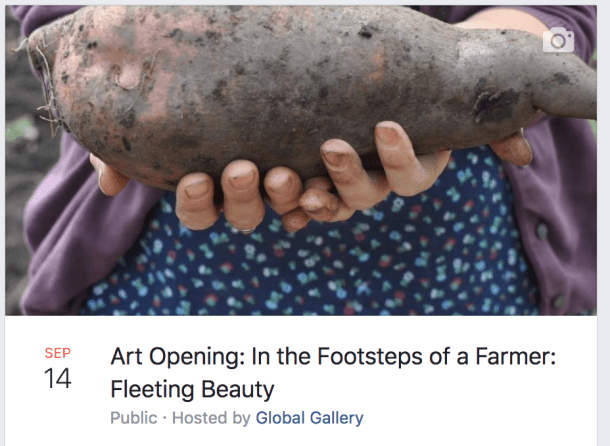
And so, it is with great pleasure that I am celebrating an exhibition of my photos at Global Gallery in Clintonville this month. The show was sponsored by the Greater Columbus Arts Council and will be up through the end of the month. I’ll be there for a reception this Friday night from 6-8pm. Hope to see some folks come out to talk about “The Work.”
This season has been rough. I was under a lot of stress in the spring in various other aspects of my life and like Tita’s emotion-infused cooking in Like Water for Chocolate, I believe it had an impact on the farm. The erratic weather (a week in the high 80s, rounds of 2-3 inches of rain over two days followed by 7 dry days…) and an influx of animal pests displaced by road and sewer constructions throughout our neighborhood didn’t help either. And so, it isn’t surprising that I haven’t posted much in this space. I didn’t feel like I had much to celebrate.
Thankfully my friends and loyal CSA supporters have assured me, repeatedly, that they’ll support our work when times are good and when they’re not so good. They understand that that’s what community supported agriculture means. When the harvest is good, it’s great, and when it’s ain’t, it ain’t.
I suppose you could say part of what members received in their share this season was emails from me outlining the challenges we faced, as we faced them. I like to think of this as the “get to know your farmer” bonus CSAs and farmers’ markets provide.
With all this going on, I had no idea two months had gone by since I posted here! And, in retrospect, it wasn’t all bad. Here are some highlights.
The Clintonville Farmers’ Market Kids’ Garden Club continued their meetings, field trips (Franklinton Farms and Rock Dove Farm), and had two great sales at the farmers market. They raked in over $100 which we’ll split between their harvest party and a donation to a yet to be determined local nonprofit.
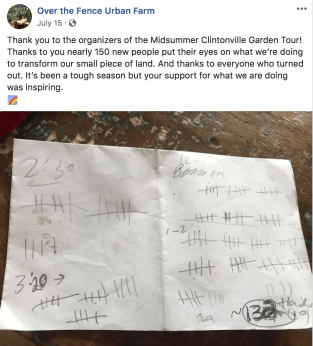
We grew popcorn for the first time this year – in the kids garden and on the farm. Visitors who stopped by for the Clintonville Midsummer Garden Tour were surprised to see it. Thanks to our early planting, it was way more than “knee high by the fourth of July!”
Edible Columbus featured me in the Local Hero column. It was great to run into people throughout the summer who saw the article. Made me feel almost famous. And appreciated.
We have a bunch of events coming up in September including the Simply Living Sustainable Living and Garden Tour – an answer to the wish my friends and I had for such an event in the spring after visiting the mainstream H&G show at the fairgrounds (see Follow-up on The Columbus Dispatch Home and Garden Show). We’ll also be celebrating the beauty of small scale agriculture at Global Gallery September 14th for a reception celebrating “In the Footsteps of a Farmer: Fleeting Beauty,” a photo exhibition sponsored by an Greater Columbus Arts Council Artists in the Community grant.
Thanks for sticking with us in the good times, and the not so good times.
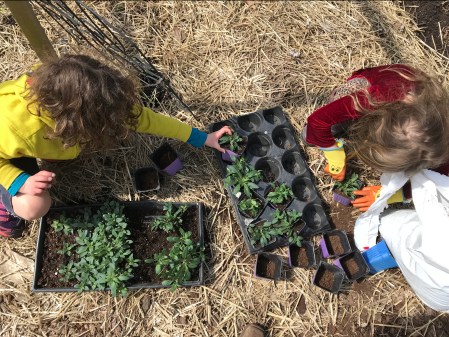
The sun was shining and The Farmers Almanac Gardening by the Moon Calendar said it was a good day for transplanting. We were lucky to have friends free to help us move some things around. Here are a few highlights.
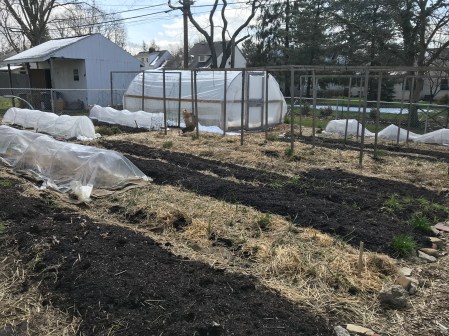
A peak under some of our caterpillars. Clockwise from top right – spinach under frost blanket (planted 2/5), potatoes under low plastic tunnel (planted 2/22: Thanks for the inspiration, Milan!), and the view inside our high tunnel panted with various herbs and greens in January).
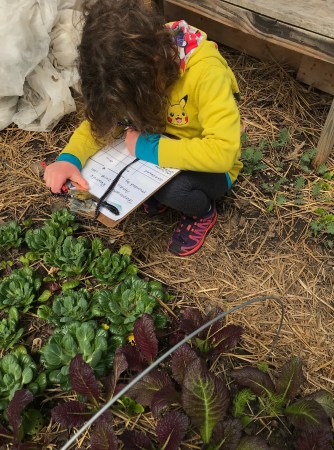
Homeschool on the farm today included measuring and recording air and soil temperature in 5 different growing situations (high tunnel, low tunnel w/plastic, low tunnel with frost blanket, glass-topped cold-frame, and no cover.)
[Warning: This, like my posts about rabbits and voles, includes discussion and images of dead animals. Vegans beware.]
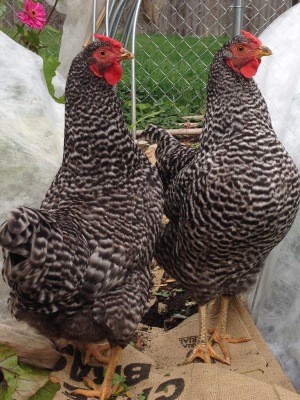
Our first flock of hens are nearing the end of their productive egg laying years. As such, we’ve been having lots of conversations around the farm about what comes next, and seeking advice and options for how to make room for a new group of ladies. In the meantime, and after a long cold winter with many days when they didn’t want to leave their sheltered run, I’ve been letting our girls roam around the yard from dusk ’til dawn.
Leaving them out on their own while I’m not in the yard with them has always been risky. We’ve had our share of predatory visitors over the years – hawks, fox, feral cats… But those risks don’t seem worth worrying about much anymore. I figure if their time earth-side is limited one way or another, they should enjoy their days as much as possible.
Still, it was with a heavy heart that I found this old biddy Thursday afternoon. All signs point to death by opossum. The only thing I’m having trouble understanding is the time of day it happened. Right around 3:30 in the afternoon. And so, for the time being, the other ladies are on fairly strict lockdown.
As usual Thompson, our farm dog, found her first. He nudged her with his nose and I joined him to investigate. We have lost chickens before, but all to what seemed like heart attacks or some other internal failure. This was the first time I saw evidence of attack. The first time I saw bloody entrails and flesh resembling what you’d find at the butcher shop. I took a moment to examine the wound, to look at her insides now that they were on the outside. This brought me one step closer in understanding the creatures that have been sharing our yard. Somehow, in death, I felt closer to her and more responsible for her than ever before.
I picked her up without any hesitation and pet her one last time. Then, in keeping with Jewish tradition of burying the dead as soon as possible, I said my own silent blessings of thanks for the time we had with her as Dan, a neighbor, and I buried her.
Last week I was offered tickets to attend the Home and Garden Show and to give tickets away to readers of this blog. (To see my original giveaway post, click here.) Thanks to all who left comments. I’m excited to hear how your plans and commitments to local food systems progress this season! In this addendum, I wanted to share my brief review of the show based on my experience attending this past Monday with some friends of the farm and our children.
In a nutshell: Chances are, if you are reading this blog you shouldn’t go to the home and garden show.
I should have predicted this based on the show’s sponsors, but I like to think of myself as someone who’ll try anything once. In short, this is a trade show not befitting DIY homsteaders or urban farmers. It’s a place for people to find others to build and plant things for them and there was little to no mention of sustainable gardening practices, planting with native species, or growing fruits and vegetables. So do yourself a favor, and stay home and get to work!
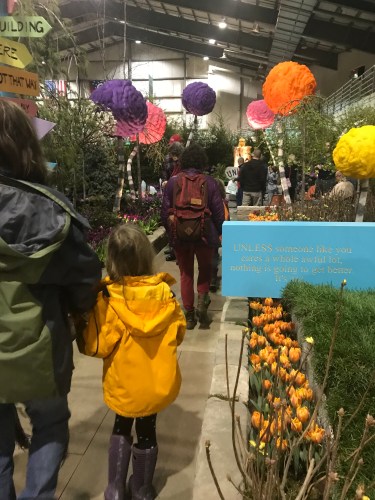
All that said, if you enjoy visiting conservatories, you’ll appreciate the picturebook-themed garden installations at the show this year. I can appreciate the effort the nurseries and landscapers put toward bringing these spaces to life inside the Ohio Expo Center.
The Lorax garden installation. Mildly amusing, but not really useful as urban farming inspiration.
In the meantime, my friends and I will be dreaming up plans for a home and garden show befitting our kind. A good place to start would be visiting any number of farms and homesteads, like ours, that host open houses throughout the growing season. Stay tuned for updates on our 2018 open houses and Ohio-based events hosted by Ohio Ecological Food and Farm Association (OEFFA) and OSU Extension.
This time of year, backyard growers around these parts are starting to dream about getting our hands back in the soil. We are pouring over seed catalogues and planning our planting schedules. We’re also cleaning up messes left from last season and setting ourselves up for success in the new one. Around here, in the dead of winter, that means cleaning up the basement.
And so it was that I came across some garden plans Dan (also known to readers of this blog as The Spurgeon General) made for a garden back in 1994 in the liner notes for a record he put out with one of his bands – the cover was a painting of a farm issue license plate…
I knew I loved this guy and I knew he had some experience gardening when we first met, but I cherished reading these notes; a window into his life with plants before I knew him. All these years later, tomatoes are still his favorite crop and we have a rototiller parked in the shed.
My own crop planning continues to evolve. In addition to planning for rotations and making sure I balance membership commitments and seed orders, I’m trying to get more sophisticated about tracking weather patterns and best planting days for different types of crops according to biodynamic calendars. I spent the last week of winter vacation comparing temperatures from last January and this one. This was my first observation for the new year.
Things haven’t changed much yet, but they’re looking up and I’m hoping to get out to the high tunnel and seed some beds this weekend.
I felt a bit uneasy and ill-prepared to represent the Jewish perspective*, but found in my preparatory reflections, and even more so in sharing them during the event, that I had unique ideas worth sharing. As an urban farmer who thinks of her work, not always but at least sometimes, through a Jewish lens, I wrestled with the questions the panel posed as I pulled together my talking points. These included:
How is food security assessed? What makes an entity “food secure?”
What is the most common misconception surrounding this issue?
How can a community mitigate the stigma surrounding food insecurity?
How does religion aid you in approaching the prospect of food insecurity? (ex. Religiously approved food).
What entity should spearhead the issue of food insecurity?
Honestly these aren’t the kinds of questions I think of regularly in relation to Over the Fence. Mostly when such questions come up I feel guilty that I’m not doing more to help increase healthy, fresh food access to people in Columbus who live on public assistance in food desserts. But thinking about them in relation to Judaism gave me new this to think about and goals to work towards.
All on the panel agreed that food security is not just about having access to calories, but a regularly balanced diet of quality foods. Currently, an overwhelming majority of the USDA budget pays for SNAP (Supplemental Nutrition Assistance Program, aka food stamps). Seems the USDA ought to be doing more to support entities like OSU and other land grant university’s extension offices, working in partnership with community organizations and farmers to produce more food on the local level. We all agreed that the industrial food system is broken. At Over the Fence we are experimenting with one model for growing food differently, in community, ensuring food security for those who participate in our CSA program in the form of access to high quality food from a known source.
I shared my sense of working in relationship with the natural world as it is informed by Jewish understandings and traditions which celebrate, for example, eating seasonally, attending to the phases of the moon, and recognizing the powerful importance of water. Jewish blessings over food often make mention of the source of particular ingredients in the food being blessed such as wine being the fruit of the vine. While I don’t say them regularly, I appreciate the potential of those blessings to remind us that food doesn’t come from the grocery store; it comes from the earth, with help from the farmers who send it to our plates. At least real food does.
The other thing I thought of as I prepared was the saying, “If you give a person a fish they’ll eat today, teach that person to fish and they will eat for a lifetime.” I did some digging and found that the original sentiment of the phrase, though not this familiar wording, dates back to a medieval rabbi, Maimonides (check out Quote Investigator for a complete discussion). As luck would have it, Maimonides, who was born in Spain, did a lot of his work as a physician and philosopher in Morocco and Egypt, working with Muslims as well as Jews. Seemed like the perfect person to talk about at this event.
Maimonides wrote about 8 levels of charity, the highest being helping someone in need help himself. Over time, his ideas were converted into the proverb we’re familiar with today. Seems pretty clear that more people would be more food secure if they controlled the knowledge and tools to produce their own food. I hope that as time goes on Over the Fence can extend our capacity to make that happen. I feel proud of the tours we give and this blog for sharing our work, but I would love to engage in more direct action towards fulfilling the educational aspect of our mission.
Last night I had the honor of sharing a story at the 43rd Pecha Kucha (PK) Columbus. It was based on an experience I had this past spring which I blogged about in Rabbit Roller Coaster.
For those unfamiliar with PK, speakers create 20 slide Powerpoints and set the slide transition timer to 20 seconds. So you have 20 seconds to talk about 20 slides for a total of 6 minutes and 40 seconds. Sounds like a nice chunk of time but it flies by! My presentation wasn’t flawless and I cursed a few too many times, but I’m proud of my efforts. I had a good time and I hope that I got some folks thinking more about where their food comes from and the trials farmers go through to get it to them with my photographs and my remarks.
I’m posting a video of the presentation here for people who couldn’t make it out to the event. I’ll be writing more later about the experience of prepping for and delivering the talk on Art Education Outside the Lines. It was a creative experience I relished and would encourage others to try. Pecha Kucha is a great venue for our stories about farming and how our food gets to people’s plates.
Special thanks to those mentioned in this story including:
This fall I watched from afar as my students in Texas and Florida prepared for hurricanes Harvey and Irma. I felt powerless to help them, and guilty that my house was standing tall, dry, and coursing with electricity. But as autumn settles into central Ohio, I’m preparing for the coming of another powerful force of nature: the Persephone Days.
From The Gods and Goddesses of Olympus by Aliki.
I first learned about Persephone Days from Eliot Coleman’s Winter Harvest Handbook (you can read an excerpt here). Put simply, folks who grow food in areas with sub-freezing winter temperatures must think as much about hours of sunlight in planning crop rotations as the cold. The Persephone Days are those with fewer than 10 hours daylight. (See a timetable for your zip code here.) Here in Columbus that means mid-November through late January.
If you plan right -Coleman has lots of recommendations – you can harvest greens and some root vegetables (including the most amazingly sweet winter carrots) grown in the fall and stored in your garden throughout that dark period. Just don’t count on your plants doing much new growing. Coleman suggests things be at least 3/4 of the way to maturity before the coming of Persephone.
I started paying more serious attention to these dates last fall as we began using our high tunnel and did some winter-sowing for early spring harvest. This year I feel behind. I didn’t get a full crop of fall greens out early enough for our family’s winter harvest, let alone a fall or winter CSA, which has been a goal for the past few years. Looking back on this field report,however, I realize I am ahead of where I was last year so… I’m learning.
This year I am homeschooling our daughter, Cora, 2 days a week. We have spent the past two months studying ancient history with a strong emphasis on the stories of the Greek gods and goddesses. Through the process I spent more time with Persephone. I got a refresher on her mother Demeter (goddess of the harvest and fertility) and Hades (god of the underworld) who, with permission from her his brother, the all-powerful Zeus, abducted Persephone to keep him company in the underworld. In her loneliness and suffering, Demeter caused a famine. Eventually Persephone was returned to her mother, but because she had eaten four pomegranate seeds while in the underworld, she had to return to the land of the dead for four months each year to keep Hades company. We experience these months as winter, the time when nothing grows. (Click here for an extended version of the story told from a contemporary and feminist perspective.)
Unlike the ancient Greeks, I don’t need a story to help me understand why the days are shorter and the nights are colder this time of year. I don’t need one, but it certainly makes things more interesting.
Following my on-site meeting with Columbus City Council Member Elizabeth Brown in May, I was asked to plan an advocacy tour for other members of the council on behalf of the loosely-affiliated Franklin County Urban Farmers Network. I worked with Carl Williams from Council Member Priscilla Tyson’s office to recruit and organize the participants and Mike Hogan from OSU Extension who reserved a 25 seat bus to take us around. And so it was that I found myself downtown Friday morning at 9am picking up Council Members Tyson, Shannon G. Hardin, and Jaiza N. Page. Representatives of the rest of the council members were also with us as well as folks from the City Clerk and Legislative Research Offices, the Public Health Department, Ohio State University College of Agriculture, Local Matters, and Franklin Park’s Growing to Green Program.
Following invitations from 10 operations around the city representing a mix of farms, community gardens, and homesteads, I decided to focus this tour on self-identified working farms in the city. Those of us who grow, sell, and regularly distribute produce through CSAs, farmers’ markets, and wholesale agreements face different issues than individuals and neighborhood collectives. The five sites we visited provided a mixed view of non- and for-profit operations, larger and smaller scale operations, on public and private land, in more and less densely populated neighborhoods around town.
Our first stop was Franklinton Gardens (FG), soon to be renamed Franklinton Farms. FG Director Nick Stanich described FG as a scattered-site farm that currently occupies 12 lots which total 2.5 acres of growing space, and more in the works. I have visited FG a few times over the years, but it had been awhile. I was amazed to see sites that were not in production a year ago filled with mature tomatoes, squash, okra, and corn. FG is a non-profit organization funded through an impressive combination of grants and donations, market sales, and a 40 member neighborhood supported CSA program. FG was a good place to begin the tour. Participants were visibly impressed and energized by the work Nick and his team are doing along with community volunteers and AmeriCorps VISTAs. Together they are transforming vacant lots of nutrient rich rich, flood-plain soil and run down houses which they have converted into meeting spaces and housing for their volunteers.
On the drive to our next stop, Mike Hogan spoke a bit about defining urban farming and differentiating it, and its challenges, from community gardening. He also raised issues related to zoning for high tunnels and on-site sales in residential areas (like ours) as they relate to the Food Action and Green Business and Urban Agriculture Plans City Council recently adopted. I was happy to hear conversations are underway with the zoning office to set guidelines for people interested in erecting high tunnels; checklists stating what’s needed with regard to review and permits for structures under and above certain size thresholds. At this time, high tunnels under 2,000 square feet are not restricted so much as the rules around them are vague.
Our second stop, Clarfield Farms, is operated by the MidOhio Foodbank as one mechanism for reaching their overall mission of ending hunger in Central Ohio. The farm sits on land beside a former Columbus City School building, breathing new life into an underutilized civic space. Before the farm was established in 2012, the school had been vacant for nearly a decade. While I have been invited to Clarfield at least half a dozen times, I never made it down before this tour. I’m glad I finally got to see what they have going on and hear more about their programming. Along with 3 – 20×96′ high tunnels and field crops, they host a u-pick plot for neighbors, and a weekly pay-what-you-can farm stand. The farm works with other branches of the foodbank (see for example South Side Roots), partners with other local non-profit organizations, and maintains relationships with local chefs. The farm also hosts a summer youth program that gives teens with 10-week apprenticeships during which they learn life skills they can apply to various personal and professional situations. We heard one young woman report on the impact the apprenticeship has had on her; at 15 she was able to clearly tell us direct and indirect ways she’s developed as a result of her time at Clarfield. Through its portfolio of operations, Clarfield demonstrates myriad ways urban farms can connect with and serve their communities.
On the way to the next stop I talked a little more about deduct meters – which came up at our first two stops. With this device installed on our water lines, urban farmers can avoid sewage charges for water that goes into the ground. Having these permitted and installed is time consuming and costly, but can save lots of money over time. Making that process easier, maybe even giving farmers a a subsidy to help pay for installation, would go a long way in supporting the work we do in our communities. I also reiterated the needs Mike set forth for clear guidelines regarding high tunnels, noting a recent round of federal grants that were offered to urban farmers in Columbus, some of whom passed up the money due to uncertainty about regulations.
Our third stop was another from my bucket list – Project Aquastar (PA) at St. Stephen’s Community House in Linden. The project has a relatively new manager, Max Slater who has a degree in urban planning and identifies as a self-taught farmer. PA is going through some restructuring including moving it aquaponics production into a new greenhouse. The project currently distributes produce through a new buy one/give one CSA program and through the St. Stephen’s food pantry. Like Clarfield, they host teen apprentices in the summer months. They have great infrastructure and it will be exciting to see how they reinvent themselves in the coming years.
Between this and our next stop, Adam Ward, Director of Government Affairs for the OSU College of Food, Agricultural, and Environmental Sciences spoke for a few minutes. He talked about the university’s Discovery Themes, specifically the Initiative for Food and Agricultural Transformation (InFACT). InFACT recently received a major grant from the Kellogg Foundation for the Buckeye ISA (Institutionally Supported Agriculture) program to help mentor low-income families interested in growing food for themselves, their neighbors, and the university. This proposal generated a lot of questions from the council members and staff, as it has in the urban farming community, and served as an interesting point of transition to our next site.
Foraged & Sown is a for-profit venture led by two women in North Linden – Kate Hodges and Rachel Tayse. The pair sell wild edibles (foraged) and grow their own (sown) culinary herbs for chefs and home chefs and tea drinkers along with other value added products like seasoned salts and jams. Like other of us farming on the north end of town (Swainway Urban Farm, Peace Love and Freedom Farm, Pettibone Urban Game), Kate and Rachel grow in their front, back, and side yards – anywhere there is soil. This kind of amped-up edible landscaping, like what we do at Over the Fence — using available space to grow food, rather than lawns — builds capacity for sustainability and resiliency in the city. But it’s not always appreciated, nor profitable.
Kate and Rachel shared challenges of dealing with formal and informal complaints from neighbors initially skeptical of their activities. Over time those have diminished, due largely to their persistence in speaking with agents who came out to investigate the complaints and inviting neighbors to see what they are doing during open house tours. Foraged & Sown provides an example of issues addressed by individual residents interested in farming on their property as opposed to the other operations we visited growing on vacant lots obtained from the city land bank, leased land from public entities like the school district, or non-profit managed properties. Legislative Analyst Sandra Lopez suggests folks like us go to our local area commissions to introduce ourselves and let those groups know what we are doing and what impact it makes on our neighborhoods. Adam Ward echoed this saying, “The worst time to build relationships is in times of crisis.” Council Member Tyson agreed suggesting “Introduce yourself when you don’t need anything, so that when you do, you’ll have relationships to fall back on.” That’s what this tour was largely about.
Our final stop was a quick swing by Over the Fence. On our short drive over, I told everyone a bit more about how I got started farming, a bit about the finances of my operation, and the ways CSA members help me keep things going and looking good. I hope I made clear that our community kitchen garden is not only providing produce to 18 households this season including my own, but also providing a space for building community. It truly takes a village to run this farm. Over the Fence is not a 501c3 but isn’t really a for-profit enterprise either. My profits are not easy to calculate; the come mostly in the forms of food and friendship. That’s alright for me, a middle-class woman with another job as well as a well-employed spouse with great health insurance, but it wouldn’t work for everyone. It requires not only additional income, but also a reimagining of how we define, and measure, profits. I’ve struggled with quantifying this in the past but I think such numbers would speak volumes to legislators, community organizers, funders, and potential future farmers.
Photo credit: Michelle Moskowitz Brown
All the farmers we visited with have already expressed interest in working together to continue communications with City Council. You can be sure I’ll blog about it here.











 Over the Fence Urban Farm