Looking forward to adding to this series.
Send us your young ones, please!

Iris in awe.

June was somewhat disappointed by this one…

Ezra…

…amazed.

Cora with a great big cluster.

Lino and Shannon.

Cora showing Hank how it’s done.

Looking forward to adding to this series.
Send us your young ones, please!
Iris in awe.
June was somewhat disappointed by this one…
Ezra…
…amazed.
Cora with a great big cluster.
Lino and Shannon.
Cora showing Hank how it’s done.
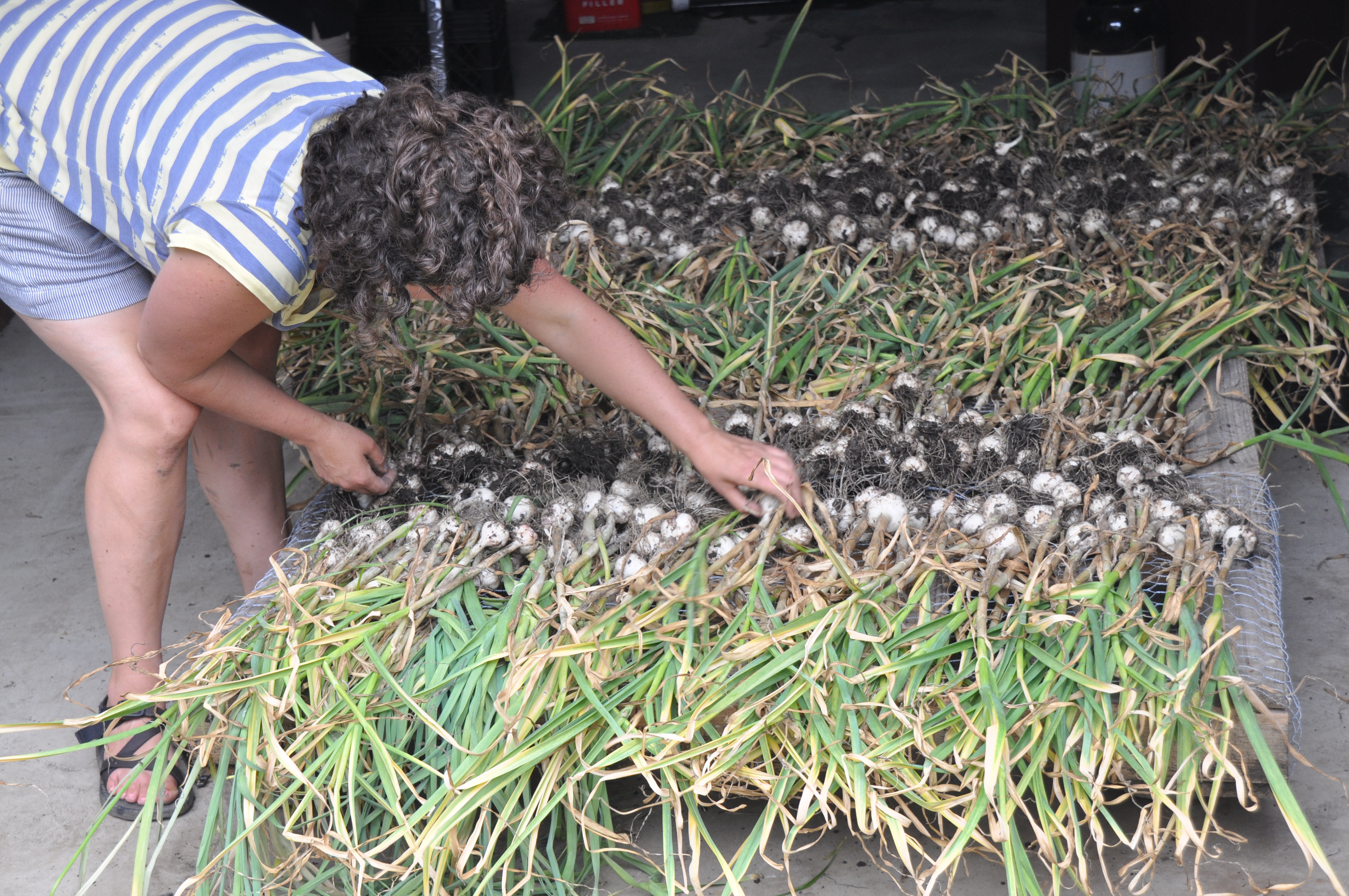
This all started when we planted our garlic back in November. Today that initial gesture came full circle as Melissa and I pulled hundreds of bulbs of garlic from the ground to cure. (We’ll have to go back and count them one of these days…)

The bulbs vary in size from super-sized to puny. Add grading by size and appearance to the to do list.
While we harvested the bulbs today, we’ve already been enjoying garlic goodness for a few weeks. When a restaurant sale fell through, we found ourselves rich in short-season scapes and tried them in a variety of recipes – pesto with pistachios, guacamole, compound butters. (Check our Pinterest recipes board for details.) Not only were they delicious to eat, the were great to have around the house. 
Our 4th of July fresh garlic and garden parsley chimichurri disappeared too quickly. Next time it will be even better as the garlic flavor matures and deepens over the curing process, which will take a couple of weeks. We’ll be sure to post some updates on that. For now, the gals are resting in the garage. Hope to get some braided in the next few days for our CSA members!
 Postscript shout out for Ron L. Engeland’s Growing Great Garlic (1991).
We are over the moon to have been included in the Summer 2014 issue of Edible Columbus. Click here for the online edition. We’re on page 59.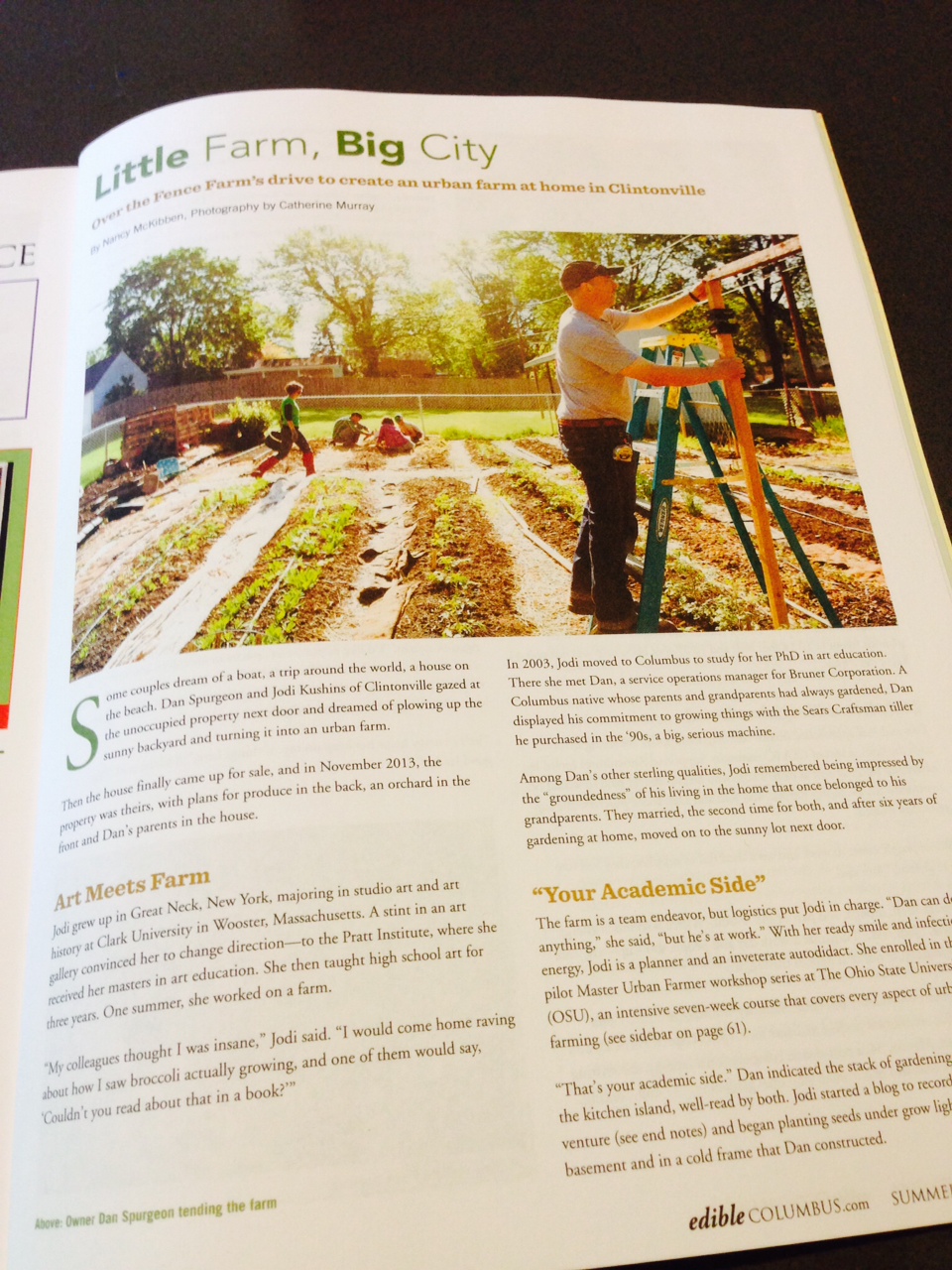
Chatting with writer Nancy McKibben gave us a great opportunity to reflect on who we are in relation to this project. Dan and I have a lot more to reminisce about – from both our individual and shared memory stores. (We’ll be sure to share some of that with you soon.) And hanging out with photographer Catherine Murray during one of our CSA workshare days was a pleasure. We were excited to see what she saw through her lens.
When the magazine came out I read our article first, of course. It was thrilling to see our efforts recognized. Even more meaningful, however, was reading through the rest of the magazine and seeing who else was included. It gives our work context. So proud to be a part of the local foods movement here in Central Ohio and to share ink with the likes of Moo, Cluck, Four Strings Brewery (Dan’s former bandmate’s latest gig), Clintonville Community Market and Flying Horse Farms’ learning gardens.
Finally, thanks to Sarah Lagrotteria for letting Edible in on our little venture.

If you’ve ever grown tomatoes you know where this is going. You know that smell they leave on your fingers when you’re pruning and training them. It’s nothing I can describe in words. All I know is I’m happy to be smelling it again.
This year’s tomato plants are extra special since we grew them from seed. The fact that some are now standing over two feet tall in the ground is nothing less than amazing. And they are just starting to show their first signs of fruiting.
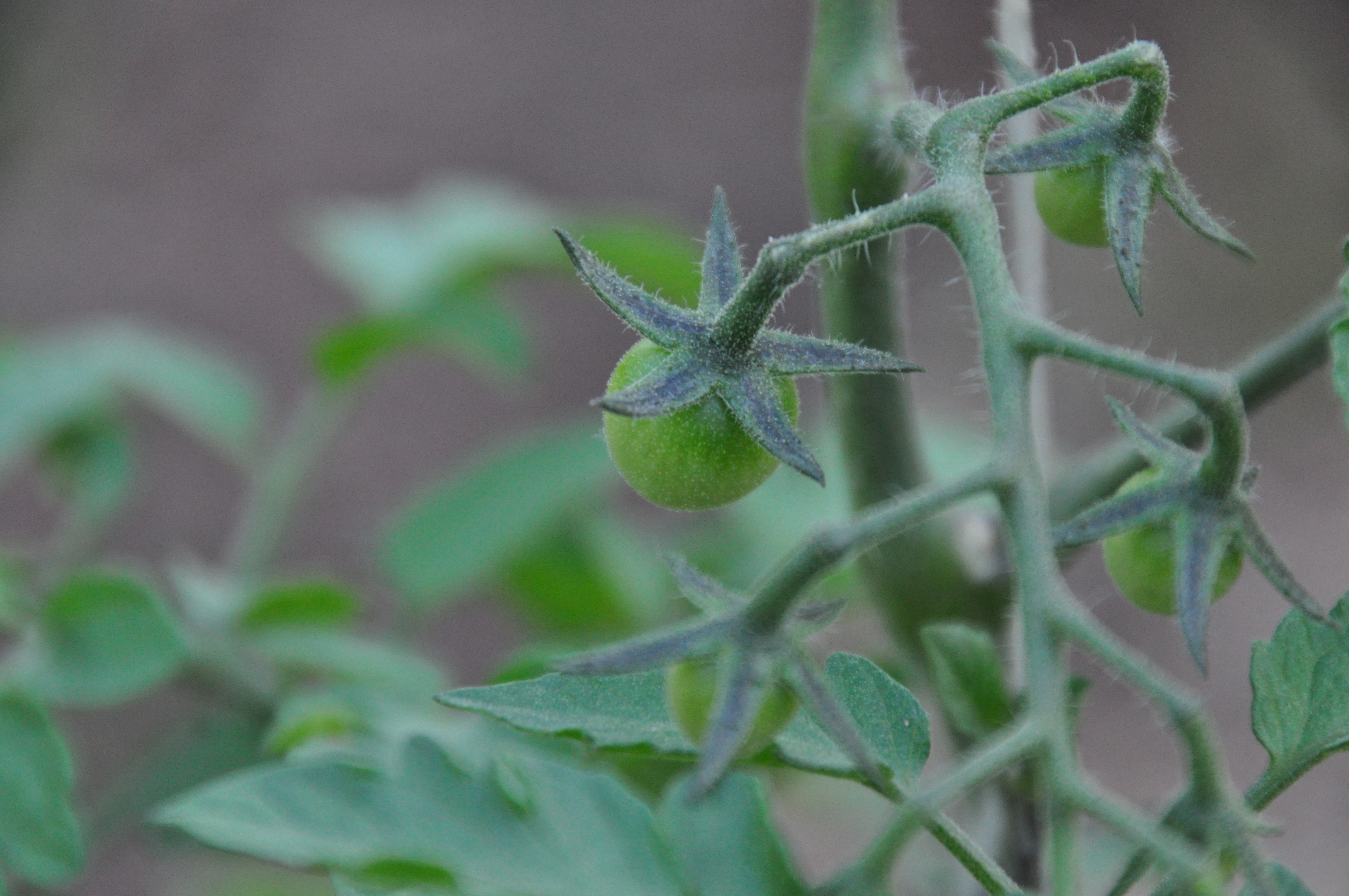 We’re mostly growing cherry tomatoes this year (see “What We’re Growing 2014” for a full list) to try to avoid some of the worst plagues of any backyard tomato grower – early blight, blossom end rot, splitting and cracking… These are all indeterminate varieties, which means they will, in theory, continue to grow and set fruit until they die from frost, so we’re training them up a line of twine.
This video explains the process pretty clearly. Hoping our CSA members will take a look to learn how to help care for the plants here as well as those they took home. Of course, if you have the space, you can just let them run wild. We’re going with this option to keep the plants from becoming a mess of vines. This should ensure good air circulation and an easier harvest.
Now get out there and get yourself some sweet smelling tomato fingers.

It’s exciting to be feeding people from the farm. Even better is hearing how much they are enjoying what they’re getting. And then, getting see what they do with the fruits of our labor.
A few CSA members shared pictures (and recipes) this week so it seems time to officially adopt a hashtag. You can use #overthefenceurbanfarm on any platform you use – Facebook, Instagram, Flickr, Twitter, Pinterest, etc. (Just be sure you spell it right! It is a pretty long tag…) Then, jump to Tagboard and search across platforms for images tagged with our sign.
Hope to see everyone contribute before the season is over!
When we were planning and ordering seeds this winter, radishes weren’t in the picture. Danny likes them but I’m not a huge fan and, frankly, we hadn’t had great luck growing them in the past. But, when one of our biggest supporters asked if we’d be growing any, French Breakfast specifically, I made a beeline for City Folks Farm Shop and picked up a nice pack of seeds.
I was overeager and sprouted some in a container on the windowsill. They looked great; in perfect rows, evenly spaced. True to their Greek name, raphanus, meaning quick to sprout, they appeared as if overnight. After transplanting and a few weeks in one of our old garden beds that wasn’t too well-ammended, we had some decent sized roots, but they were mangled and spotty. Still, I was hopeful. When we pulled the first ones from our new, extra-long rows, I was amazed. They were beautiful. (See previous posts for pictures). Shout out to Milan at Peace, Love, and Freedom Farm for his great advice on fertilizing! The fish juice, ample seedling thinning, and lots of space did their magic and we had enough radishes for all our CSA members this week.
Of course, some folks, including me, took convincing that these humble shoots were worth our time. Research and education were in order. Here’s some of what we’ve learned so far and been sharing with our people as we share our wealth.
While the roots are pretty and tend to get most of the attention, it turns out radish greens are a superfood. They are packed with Beta carotene, Vitamin C and Calcium (surprise!).
They make a great addition to salad mixes. They are dense and flavorful, if a bit scratchy when allowed to grow large.
But, not to worry because, like most any leafy green, you can use the greens to make pesto. And now that you know how healthy they are, why wouldn’t you?
Radishes are so satisfying to grow and took only 5 weeks to mature in our early spring garden. They are satisfying to harvest too. The kids had a blast with that task. I was kind of jealous…
We’ve already got more in the ground and will be ordering seeds in bulk next season.
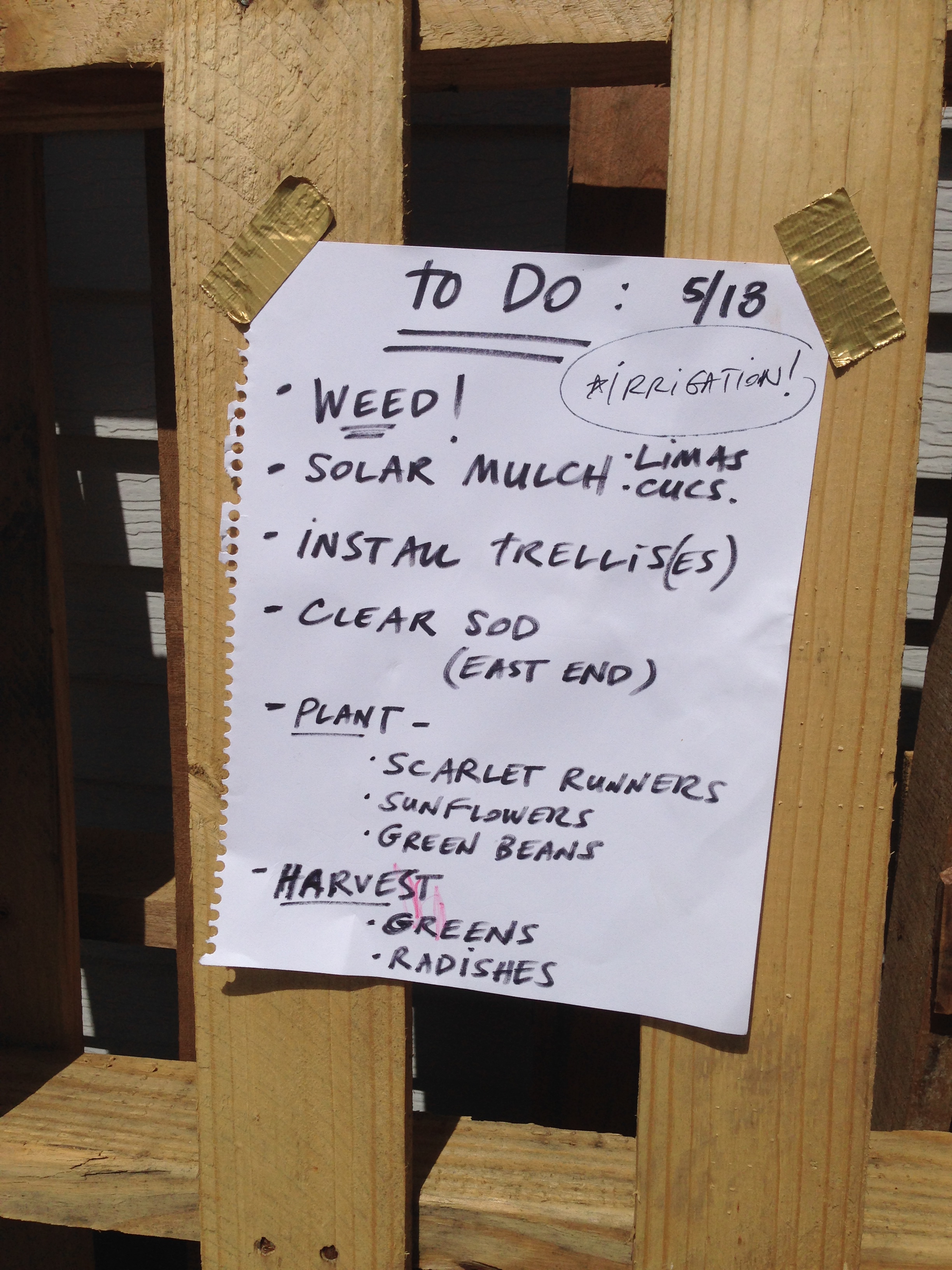
Well, this day turned out to be pretty freakin’ amazing.
When we woke up at 7am, it was all of 36 or 39 degrees out, depending on which app we were consulting. It was cold and wet and not feeling like it was gonna be a good day for much of anything.
By 9am when our CSA members rolled in, it was 50°. The sun was making a grand entrance. Catherine Murray of PhotoKitchen, a photographer freelancing for Edible Columbus, followed and we before we knew it we were working our tails off, sharing stories with Catherine, and feeling beautiful.
Once again, I’m too tired to do more than share glimpses with you via photo annotations.
Wish you were here.
Not pictured:
Planting flowers, pole beans, more radishes, chard, and arugula.

Nancy McKibben, who is writing about us for Edible Columbus‘s summer issue requested a list of what we’re growing this year. We thought our CSA members and others might also be interested.
Since we are treating this like a community kitchen garden, you’ll notice that we have a pretty wide range of things. In the future, we might limit this somewhat depending on what does best and to build on market demand. We made selections based on descriptions of taste and color, pest and disease resistance, and our research on varieties that do well in vertical growing situations.
Here’s what’s coming up in 2014!
Kale: Red Russian and Lacinato “Dinosaur”
Lettuces: Mizuna, Apollo Arugula, Red Sails (heat tolerant), Fresh Heart Romaine
Chard: Rainbow, Silverado
Beet (We’ll selectively harvest greens for salad mix and bulbs later on): Bull’s Blood, Rhonda
Garlic: Chesnok Red
Onion: Red Zeppelin
Sweet Potato: Beauregard
Radish: French Breakfast, Easter Egg
Carrot: Necora
Tomatoes: Black Cherry, Yellow Pear, Toronjina, Sweetie, Large Red Cherry, Sakura, Annelise, Gilberte Paste, Juane Flame
Serrano Peppers
Tomatillos
Beans: Blue Lake Pole, Christmas Lima
Peas: Oregon Sugar Pod, Green Arrow Shell
Squash: Green and Yellow Zucchini, Red Kuri Winter Squash, Delicata
Flowers: Zinnia, Cosmos, Coneflower, Goldenrod, Dahlia, Sunflower, Daisy, Asters, Bee Balm
Herbs: Borage, Parsley, Cilantro, Sage, Rosemary, Chives

 Over the Fence Urban Farm